Friday, October 1, 2010

The Great River Amazon Raft Race 2010

After only spending a few days back in Lima after my trip up to northern Peru, I set off on another vacation! I was heading up to the jungle to compete in the 12th annual Great River Amazon Raft Race. We started out by flying to Iquitos, which is the largest city in the world (population: 370,962) that is inaccessible by car. The only ways into or out of the city are flying or boating. The city is filled with "motocarros", which are modified motorcycles that have a carriage attached for passengers to sit. As far as I can tell, the drivers are crazier than drivers in Lima, but traffic isn't nearly as bad because there are not nearly as many "combis" that cut people off and back everything up. While in Iquitos, we bought some tools and equipment that we'd need for our race, including: wire (to hold logs together), nails, hammers, machetes (best tool ever), a tarp, seat cushions, and more.

Minnesota Vikings #80 Cris Carter jersey on a motocar driver in Iquitos

Spider on the wall of the hostal (welcome to the jungle!)
Waking up early Thursday morning, we all took a shuttle to the city of Nauta. Nauta is about 60 miles away by car, and is just about the only place that you can drive to from Iquitos. When our busses stopped about a half-mile outside of town, everyone was a bit confused. They told us all to get off the bus and start walking. It wasn't until a few minutes into this walk that we realized that we were not only in a parade, but we were the parade. There was a band leading us into town, and many of the locals from Nauta came running up to the street to cheer us on as we came marching in.

After a brief reception ceremony and lunch, we all hopped onto boats that would bring us to the other side of the river to construct our boats. I was on a team with three others that are also in Lima doing research for the same doctor (Bob Gilman), Danni Kirwan (UK/Bolivia), Daniel Karlin (USA), and Síle Molloy (Ireland). We were hoping to find a fourth Dan to fill up our boat so we could be called "Team Dan" or something similar, but we were more than happy to have Síle along with her Irish accent. We decided to go with a construction theme and be called "Bob's Builders". We figured that if we wore construction outfits, we might be able to actually build a decent raft. However, instead of being the construction workers, we decided that we were better suited to be the foremen and hire some cheap local labor to do the work for us...

Parading into the city of Nauta

Welcoming ceremony in Nauta

Building our raft (aka watching two Peruvians build our raft...)
Our raft turned out to be a beauty. All eight logs were placed side-by-side and we had an excellent canopy over our heads to block us from the sun. We were also the smartest of the 49 teams that were competing, as we decided to buy a floatie to drag behind the boat to relax in and get a tan. By the end of Thursday night, we were definitely ready to get started on our three day, 120 mile journey back to Iquitos.

Our balsa raft - complete with four chairs, a roof, and a floatie. I think the only thing we were missing was an air conditioner and a cooler...

Relaxing in the floatie before we even got started...
I've floated down a river before, but I don't think that going to the Apple River with friends over the summer is adequate preparation for what we were about to do. I've also been canoeing in the Boundary Waters in northern Minnesota many times, so I thought that I'd be prepared for the journey ahead. I was wrong. Paddling a raft is HARD work. It doesn't move nearly as smoothly as a canoe, and with the big canopy over our heads, really only moved where the wind wanted us to move (sometimes backwards...).

We started to (kind of) figure out the currents in the river. If there was a beach on one side, the current was on the other. That's about as far as we got. And if there wasn't a beach... we just paddled without a current. Our strategy the first day was to take 30 consecutive hard paddles, followed by a short break, then repeat. After finishing ~42nd we decided we needed a new strategy on day two.

The strategy for day two was to sing while paddling to try to take our minds off the fact that we were going to be on the river for 12.5 hours that day. We would take requests from other rafts as we passed them, and we were going so fast that we would often finish the song when we were so far away that they couldn't hear us. This turned out to be a much better strategy.

Whenever we caught up to one of our friends' rafts, we'd stop and tie up with them and swim for a bit to relax. This was a little nerve-racking at first, as I've always had somewhat of an Amazonaphobia with all of the unknown creatures swimming with us - piranhas, alligators, sting rays, the little parasitic fish that swims up your urethra, etc. After the first few times jumping in, that fear was gone and I was able to have a great time.

Matt, Josh, and Dan relaxing during the second day of the race

Josh and Dan jumping into the water

Karen and Síle hopping in

Karen, Mary, Síle, and Danni taking a dip

Me doing a back flip off the raft
As I mentioned earlier, we were out on the water for 12.5 hours on the second day. Considering there is only about 12 hours of daylight and we left an hour-and-a-half after sunrise, you can do the math to imagine that we were out on the water for a beautiful sunset and the darkness that followed. Luckily, we were only out on the water for less than two hours in the dark, and could see the lights of the town that we were heading towards the entire time.

Sunset on the Amazon River

The third day was supposed to be the "easy" day of the trip. They said it would only take us about four hours to get to Iquitos. They were wrong. What we figured out after we arrived, is that the time that they told us is the time that it takes the Peruvian teams. We took twice as long as them, and the third day was not all that easy.

It started out relaxing, as we were singing more songs and swimming for the first three or four hours of the day. This left us ample time to get some sun, watch some dolphins, and enjoy the beautiful surroundings. However, as the day went on and we started to paddle, things got much harder. First of all, we had to fight the current to cross over to the left side of the river. Many boats did not accomplish this and were disqualified because they had to get towed after they missed our "exit". Next, we had a very fast-moving current right along the shoreline approaching the city of Iquitos, which seemed nice, until we realized that we had to avoid boats and barges along the way that were trying to use the same current.

After our boat barely, but successfully avoided all of those obstacles, we were put head on against the current for the last 300 meters. We were all paddling as hard as we could, and were probably only moving about 10 meters per minute, if that. We finally made it to the finish line after a long and grueling push and were all relieved to see the other boats finish right behind us as well. Of the five boats of gringos that came up from Lima together, four of us arrived at the finish line within about 15 minutes of each other. I still haven't seen the official results (they are still in the hands of the regional government for some reason...?), but I will update this post with our total time and what place we got as soon as I find out!

Karen, Josh, Mary, and Matt (another Gopher!) relaxing on the third day with us

Danni trying to kill dinner for us. The alligator sandwich that night was delicious!

Bob's Builders at the finish line (somehow even with enough energy to jump!)
Most of the gringo group after the race

The sign was a personal gift to me from the mayor of Nauta?!  It seemed like a perfect covering for us to get naked and stand behind it...
After the raft race, I was going to do a survival course in the rain forest for four days/three nights. This is the same course that the Peruvian military puts their soldiers through. It sounded completely awesome. Unfortunately for me, I got sick and didn't think that it'd be all that safe to head off into the jungle when I wasn't feeling 100%. I guess that's one thing that is still going to have to be on my to-do list.

Instead, I just ended up hanging out in Iquitos with one of my roommate's raft-mates named Renee. We went to a butterfly farm one day, and just ended up finding a hostal with a pool for the rest of the time, as we needed some way to keep cool in the 100+ degree weather!

Flood plains in Iquitos. All of the houses are built on stilts so that they can still use them after the waters rise. Out in the distance are corn fields that they will be able to harvest before the river rises to cover them.

A bucket of live suri, a delicious grubworm that is a delicacy in the Amazon

Eating suri! (I'll try to get a video of it posted on here eventually... once I figure out how!)


Grilled suri.... yum!

Wild pineapple

Entrance to the butterfly farm
Posted by Picasa

Monkey hanging around on the deck

A squirrel monkey. It happened to be the smallest in the area, but was also the alpha male. It tried to go to the bathroom on me as I walked by...

Two parrots

A Caiman in the pond

A cool black and blue butterfly

Another butterfly

And another

A jaguar!

A barge carrying logs down the Amazon
As a side note to all of this, I just have one request if any of you ever end up in a place as beautiful as the Amazon Rain Forest. Don't destroy it! It's sad enough to hear and see the deforestation going on as we were floating by, but what was equally horrible was seeing all of the plastic water bottle floating in the river from the boats ahead of us that we had to pick up. Whether you're in the Amazon, along the Inca Trail, or even in the Boundary Waters or anywhere else that you like to go that is a naturally beautiful place - don't ruin it for the rest of us!

That's all for now... My dad is coming down in about two weeks to do the Inca Trail with me, so my next update will probably be after that!

Saturday, September 18, 2010

Traveling around Peru

I know I said that Rob and I were going to go to Huacachina to go sandboarding, but we decided to change up the plans a bit. We decided instead to go to a fútbol game. I gave him a warning that these fans were a lot crazier than any that we've seen before (**see note below). They start fires in the stands, never stop jumping and singing, throw things at opposing players, and have to be surrounded by riot police at all times to attempt to control them. We managed to find our way into the VIP section (midfield seats in the shade) thanks to my friend Carlos. Even in those seats, we heard people yelling at opposing players with phrases that I don't think I shouldn't repeat here, even in Spanish as my parents might figure out how to use google translate one of these days...

**A little background between Rob and I... we like to go sporting events together. Twice during college, I drove out to Lincoln, Nebraska (where Rob goes to school) to go to a Cornhusker football game (even missing Thanksgiving one year), I've driven with him to Chicago to go to a Twins - White Sox series, to Green Bay, Wisconsin for a Vikings - Packers game (Favre's first victory AGAINST the Packers), and countless Twins games since we were 13. 

The view from the VIP seats at the Alianza Lima game
The weekend after Rob went back to the States, I decided that I needed a vacation! Along with several other gringos, we went down to Ica, Huacachina, and Lunahuaná. We toured three different wineries in Ica, and acted as their taste-testers of their piscos and wines. My favorite was the wine called Perfecto Amor, because "cuando lo toma, probablemente vas a quitar tu ropa antes del fin del noche" and I bought a bottle. Here are a few of the pictures from the tours... to see all of them, check out the Picassa web albums to the right. 

In the stomping pit with Mika showing us her stomping form.

I think that's the fermenting pit that I was escaping from?

Our selection of piscos and wines to test

Another winery's historic factory
After the winery tours, we took a taxi to Huacachina to go to a disco (bar). At about 2 am, most of the group headed back, but my friend Kristyn thought it'd be a good idea for the remaining four of us climb the top of a sand dune (read: sand mountain) and watch the sunrise. We thought that it was a great idea and we went for it. With the help of the bottle of pisco we brought along as fuel, it was one of the greatest (and most well-deserved) sunrises that I've seen in my life. 

Party at a hostal in Huacachina

Sunrise from the top of a sand dune

American flag : accomplishing an impossible mission like going to the moon : : Empty bottle of pisco : accomplishing an impossible mission like climbing a sand dune after drinking a bottle of pisco
Considering we didn't get back to our hostal in Ica until 9:30, we didn't quite make it to the sandboarding with the rest of the group. We heard it was fun. I've already done it, so my bed was much more appealing at the time. After the rest of the group got back from sandboarding, we all headed by bus to Lunahuaná. After some bargaining (begging) by us at a hostal, we found some rooms (read: closets that they put mattresses in) to stay in for the night. We woke up to go rafting the next day and relax in the sun (which we haven't seen in Lima for quite a while).

Danni, Mary, Marlene, Sile, Matt (another MN boy), Kristyn, Karen, Josh, Daniel, and me before the rafting adventure
After a week of work in Lima, I went up to northern Peru to help out Christina with her project. She is working on creating a census of a small mountain village and investigate the prevalence of Chagas disease and offer treatment to those who have it (we don't have the results of this village yet, but it should be more than 10% of them). 

I took a plane to a city called Chiclayo, then took a seven hour bus ride to the town of Buenos Aires (population: <20 families), where there is a house available during the research project. We were one of the few houses with electricity, and were about an hour away from cellphone or internet access. The village that we went to was called Campo Florido and was about a two hour drive through the mountains on a dirt road that is impassable when it rains, thanks to mudslides. Christina told me a story of how she was once trapped on the road with her taxi driver for 24 hours before the road was in good enough condition to continue. 

In Campo Florido (population: ~300), I helped to add everybody in the town to the census and get them ready for blood donation. Only about half of the town showed up for the study, but we were still busy all day. Waking up at 5:30 to drive to the town and skipping breakfast and lunch, we were starving when we finally made it back to Buenos Aires. After dinner, we ended up working with the blood samples until 4:30 in the morning (essentially 23 straight hours of working). I thought that I've worked long days in the cadaver lab at TRIA before, but nothing compared to that!

Our house in Buenos Aires

The road to Campo Florido
Lilia taking blood for the research project
The town and soccer field of Campo Florido

Working with stool samples...
After work, I had a chance to play soccer and volleyball with the other kids in Buenos Aires. I remember always seeing my old dog Wynston chasing soccer balls in the middle of my sisters' games, but something I've never seen before this trip was a pig doing the same thing. Okay... the pig wasn't chasing the soccer ball, but instead would chase whoever kicked the ball at it whenever it got hit. I even won a sol ($0.35) while playing volleyball! It looks like my 1 credit volleyball class last fall is already starting to pay for itself!

Playing volleyball with some of the kids (I won my sol from kids my age, not these kids... I promise!)

That is pretty much what I've been up to lately. I am currently working on: writing up a journal article for the project I worked on when I first arrived, doing background research to start a new project, and doing whatever else I can to help out other people's projects. I found out that we made it past the first round of the Gates Foundation's grants, and if we receive that, then I'd be able to come back again and finish up doing research down here for another several months!

I decided to put off medical school applications for this year. I want to keep working and getting more experience before applying again. I'll keep you updated as I make new decisions on what I'm doing.

On Wednesday, I'm flying to Iquitos to compete in the Great Amazon Raft Race. This is a three day race 112 miles down the Amazon on rafts that we have to build. After I finish the race, I am hoping to do a survival expedition, where I'll have to learn how to survive in the Amazon for five days without any supplies.

In other words - I hope that I will be back in about two weeks to give you a new update...

Tuesday, August 10, 2010

Salkantay Trek to Machu Picchu

After a TON of pestering from my mom for an update, I figured I'd try to take a break and get some pictures up here. Life has been moving very quickly during the past few weeks. First of all, we had all of the gringos over (and some Peruvians too) for a party at our apartment. Beto and Beth wanted to host a party in their new apartment, so we had our friends over and had some Maracuya (passion fruit) Sours, which are made from maracuya, pisco (a Peruvian liquor made from grapes), jarabe de goma (sugar syrup), and egg white. Delicious.

Maracuya Sours at my apartment

My friend Rob Pletscher arrived in Lima about three weeks ago, and we have been on-the-go ever since. As he puts it, there is never a day when people don't want to make plans with us. He is staying for a total of four weeks, and we didn't really have anything planned, other than an 8 day trip to Cusco. Everything else that we've done, we just decided to let happen.

For the first week that he was here, we stayed in Lima. I introduced him to most of my friends down here, and showed him around different parts of the city. Every day, we did something different, whether it was coming to my work at the hospital, going to teach English lessons to Beto's dad, Luis, or hanging out with different friends. After 5 days of this, we were exhausted and the trip to Cusco came at a perfect time.

Cusco was the center of the Inca empire several hundred years ago. The name Cusco literally means "navel" in Quechua (the language of the Inca people), as they figured that it was the center of the world. The city is filled with ruins from the Inca, but sadly many of them, including most of the largest temples, were destroyed when the Spaniards conquered the area in the 1500's. An interesting fact is that the original Inca buildings are able to withstand the frequent earthquakes that Peru experiences, and many of the Spanish buildings continue to fall.

We spent two days in the city taking pictures, eating, and resting as we needed to adjust our bodies for the Salkantay Trek. This trek was one of the most amazing things that I have ever done in my life. Having already seen Machu Picchu in January, I wanted to find a better, more adventurous way to see it the second time. We woke up at 4:00 in the morning (what would start to be a common occurrence), to take a three hour bus ride to the city of Mollapata (2830 meters (9300 feet) above sea level). Our first day of hiking was about 8 hours uphill to the city (and by city, I mean there was tents set up for us, and a building that had "bathrooms" in it...) of Soraypampa, 3700 meters (12100 feet) above sea level. Below are a few pictures from the first day. If you take a look at my Picassa web album, you can see all of the pictures (more than 400).

View of the mountains during the first day of hiking

Rob with Umantay Mountain in the background

Rob and I approaching the mountain


After spending that night in below-freezing temperatures (reminding me of last years' hunting/camping trip in November with Greg), we woke up at 5:00 to start the day's ten hour hike. Each morning, our guide would wake us up by opening up our tent and giving us coca tea. Unlike its powdery neighbor that you might be thinking of, the coca leaves are not considered a drug (at least, not in Peru...). It is a natural way to help suppress your appetite and thirst, while giving you more energy and trying to get rid of your headache. I'd bring back some of the coca leaves for you to try when I get home, but I don't think that the customs agent would be so happy with me...

This second day would be the hardest day of the trek, as we were all (except for the Spanish triathlete that ended up in our group) somewhat tired from the day before, and the first four hours of the trek were very steep and uphill. Rob and I switched off carrying the backpack, so before you go making fun of me that he is always wearing it in the pictures and I didn't do anything (looking at you sis), just keep that in mind. Here are some pictures of the second day of the hike.

Sunrise over Salkantay Mountain (6271 meters (20,574 feet) above sea level)

Panoramic view of the sunrise

Proof that we made it! The highest point of the trek: 4650 meters (15256 feet) above sea level. To put this into perspective, the summit of Vail is at 11,570 feet... over a half-mile lower! My parents back home in Arden Hills, MN are sitting at 980 feet...
The second night was slightly more enjoyable than the first. We had descended to 2850 meters (9350 feet). The only thing that resembled the cold from the first night was the beer that we had to celebrate making it over the highest point. However, the worker that set up our tents thought that it was a good idea to put them on a hill. Sleeping while slanted is not that easy.

We got to sleep in the next day (until 6:00!), and were still woken up to more coca tea. The third day was an "easy" day. Only 6 (read 8) hours of hiking, and it was all downhill. After about an hour of hiking, we were walking behind a young boy riding a horse when he suddenly fell off. There were no doctors around and it was clear that he had broken both bones of his forearm. We had to think fast and create a brace and sling to immobilize his arm, and gave him some ibuprofin for the swelling and pain. I gave his parents additional ibuprofin to make sure that he would have enough for the several-hour trip to the nearest doctor. Looking back on it, we should have given the family some money as well, at least enough to get to the doctor, because the people that live in the area are so poor, that it is possible that they couldn't even afford to seek medical attention on their own.

After the boy went on his way with his parents, we continued our hike. It was generally a very easy day, and we ended up in a town called Playa. From there, we took a 20 minute bus ride to Santa Teresa to visit some natural hot springs for some R&R. A hot spring had never felt so incredible in my entire life, than sitting in there with the group, drinking a beer, and trying to get our bodies in shape for the next day. Below are some pics from the third day. Unfortunately I don't have any pictures of the boy's arm before and after the brace or the hot springs (pics I found online...), but I'm sure you can imagine what they look like!

Rob and I with clean clothes on (something that wouldn't happen again until day 5...). Note to self: bring more t-shirts when I do the Inca Trail in October...

A waterfall along the way

Day 4 was definitely more difficult than the third day. We woke up early again (more coca tea), and starting from 2200 meters (7200 feet) above sea level we hiked 3 1/2 hours up (up to 2700 meters), and 3 hours down to a town called Hidro Electrica (even those of you that don't speak Spanish should be able to figure out that translation...). Along the way, we caught our first glimpse of Machu Picchu. We also had great views of a waterfall, and generally the best pictures of the trip up to this point. After lunch in Hidro Electrica, we walked another 3 hours in the hot sun along a railroad track to Aguas Calientes (aka Machu Picchu Pueblo). Below are pics from the fourth day.

Our first view of Machu Piccu (the valley in the middle of the picture)

Group picture from a lookout point over Machu Picchu (my head is actually covering the city of Machu Picchu... sorry!)

Rob and I crossing a bridge along the trek. The water was FREEZING but felt incredible when we decided to hop in!
The fifth day of the trek is what we had all been waiting for. We all woke up at 3:00 to go wait in line at the base of Machu Picchu. There were hundreds in line, waiting for them to open up the gates at 4:45, when there would be a mad rush up the mountain for 45 minutes. Think of the land rush in Oklahoma back in the day, when the first person there wins. In this case, the first 400 people won, but there was still a mad dash along an old Inca path. The reason for the rush is to get a ticket to be able to climb Huayna Picchu (they only allow 400 per day), where you can see the most incredible views of Machu Picchu that you could ever imagine.

We got up to the entrance of Machu Picchu and were about 30th in line (not bad considering I haven't worked out since.... ummmm.... a while...). The first person to the top: the triathlete from Spain that was in our group. I can only imagine that if my sister Katie was on the trek (also a triathlete), she would have been competing for his spot. When we entered Machu Picchu, there was clouds and fog everywhere, and we couldn't see anything! We still got some pretty neat pictures, but we were hoping that we'd actually get to see the great views that you see in postcards and on the Discovery Channel! 

At 11:00, Rob, Pablo (another one of the Spaniards that was in our group), and I started our ascent (more stairs - except these ones were even steeper) of Huayna Picchu. I'm still unsure how the Inca people were able to run along these stairs... some were as high as 3 or 4 steps combined back home, and the Incas were not a very tall group of people. We reached the summit about about noon, just in time for all of the clouds to clear out and give us great views of the entire "Lost City of the Incas". Although I had already seen this in January with my other sister, Annie, it was still just as incredible. Possibly even better, after all of the hard work that was put into getting there. 

Our guide wasn't very informative, so the group just followed me around the city for a while and I explained things that I remembered from my first time here. After I see the city again for a third time in October, I should really just apply to become a guide... Anyways, here are the pics from the fifth day.

Waiting in line before the rush to the top

Our first view from inside the entrance
The reason my mom thinks that I don't have a girlfriend...

Staring contest

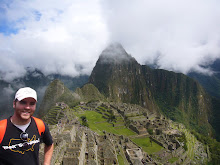
The view from the top of Huayna Picchu (and probably the only thing that can get me out of bed at 3:00 in the morning to go run up a mountain)

Looking down at the ancient city

Why did we just do this again?

Our new friend Pablo, a medical student in Spain. We convinced him that his next trip is going to be to MN to check out the boundary waters...

Great view on the way back down Huayna Picchu

Panoramic shot from the guard tower

Stereotypical postcard picture of Machu Picchu. The tall mountain in the middle is Huayna Picchu.

Rob and I in what seems like a photoshopped picture
We've just been trying to recover ever since we got back. We still have blisters on our feet and our knees still are bothering us, but it was an absolutely incredible trip! Make sure to check out the rest of my pictures for many more incredible views of the mountains, a few condors, and lost inside the city of Machu Picchu. 

We are going to go to Huacachina this weekend to go sandboarding, so I will have another update soon with pictures from that!

That's all for now!